
Dubai’s property market attracts buyers from every corner of the world. Investors from Europe, Asia, the Americas, and across the GCC purchase here for the yields, the regulatory environment, the tax-free returns, and the long-term capital story. But for many of those buyers, the property sits in Dubai while they live elsewhere.
That raises a practical question most developers never answer: once you have bought, how do you actually manage it from thousands of kilometres away?
The short answer is that remote property management in Dubai is entirely achievable, and for owners of the best investment properties in Dubai Island and similar prime locations, the infrastructure to support absentee ownership has never been better. But it requires the right setup, the right partners, and a clear understanding of how the system works.
This guide covers everything you need to manage your Dubai property effectively without being in the country.
Before setting up any system, be clear on what managing a Dubai property from abroad requires on an ongoing basis:
| Responsibility | Frequency | Can Be Delegated? |
|---|---|---|
| Finding and vetting tenants | Per vacancy | Yes, via agent |
| Tenancy contract and Ejari registration | Per tenancy | Yes, via agent |
| Rent collection and transfers | Monthly or quarterly | Yes, via agent or POA |
| Maintenance coordination | As needed | Yes, via property manager |
| Service charge payments | Annual | Yes, via standing order or POA |
| DEWA bill monitoring | Monthly | Tenant’s responsibility (confirm in lease) |
| Owner Association compliance | Annual | Yes, via property manager |
| Insurance renewal | Annual | Self-managed or agent |
| DLD renewals and regulatory filings | As required | Yes, via agent or POA |
Almost every operational aspect of owning a Dubai property can be delegated. The key is building the right delegation structure from day one.
A Power of Attorney (POA) is the single most important legal instrument for any overseas property owner in the UAE. It authorises a trusted person, typically a property manager, a legal representative, or a trusted local contact, to act on your behalf for defined purposes.
In the context of property management, a POA can authorise your representative to:
A UAE property POA must be notarised in the UAE or, if executed abroad, attested through the UAE embassy or consulate in your country of residence and then further attested by the UAE Ministry of Foreign Affairs. The process takes time, so initiate it early, ideally before or immediately after handover.
Your POA should be specific rather than general. A broadly worded POA carries risk. Define clearly what your representative is authorised to do and, equally importantly, what they are not.
For overseas investors, the property management company is the most consequential relationship you will have in Dubai after your developer. Choose carefully.
A full-service property management company in Dubai handles:
Management fees typically range from 5% to 10% of annual rental income depending on the level of service. For short-term or holiday rental management, fees are higher but gross yields are also higher.
When evaluating property managers, ask:
A manager with strong presence in your specific building has an advantage. They understand the building’s Owner Association, know the common maintenance issues, and have established contractor relationships for that development.
Operating as a landlord from abroad requires a working understanding of Dubai’s rental regulations, even if your property manager handles the day-to-day.
Ejari registration is mandatory for all rental contracts in Dubai. Every tenancy agreement must be registered through the Ejari system. Without this, the contract has no legal standing and cannot be used for visa applications, utility connections, or dispute resolution.
RERA rental index governs permissible rent increases. Landlords cannot increase rent beyond the percentage permitted under the RERA Rent Calculator, which is based on the property’s current rent relative to average market rates for the area. Your property manager should run this calculation before any renewal negotiation.
Notice periods under Dubai tenancy law require 90 days written notice for any rent increase, and 12 months written notice if you intend to reclaim the property for personal use or for sale with vacant possession. These notices must be served via registered mail or notary public to be legally valid.
Dispute resolution is handled by the Rental Dispute Settlement Centre (RDSC) at the DLD. If a dispute arises with a tenant, this is the correct forum. Your property manager or a UAE-licensed legal advisor can represent you there.
Collecting and repatriating rental income from Dubai requires some financial planning for overseas owners.
UAE bank account: Many overseas investors maintain a UAE bank account to receive rental payments, pay service charges, and cover maintenance costs without the need for international transfers on every transaction. Opening a non-resident bank account in the UAE is possible but requires documentation and an in-person visit in most cases. Some banks now offer remote account opening for property investors.
Currency considerations: Rental income in Dubai is paid in AED. Repatriating to your home currency introduces exchange rate exposure. Consider whether you want to convert periodically or accumulate AED and convert at favourable rates.
Service charge payments: Service charges are billed annually and must be paid to the Owner Association. Set up a mechanism to ensure these are paid on time regardless of your location. Unpaid service charges accrue interest and can complicate future resale.
Tax reporting: Dubai has no property tax, no capital gains tax, and no income tax on rental earnings within the UAE. However, your home country may require you to declare overseas rental income and pay tax on it locally. Consult a tax advisor in your country of residence.
The rental strategy you choose affects both your yield and your management complexity from abroad.
Long-term rental (12-month contracts) offers predictable income, lower management intensity, and a straightforward Ejari-registered tenancy. For overseas owners who want minimal involvement, a long-term lease with a reliable property manager is the simplest model.
Short-term rental (holiday lets, furnished apartments by the night or week) offers higher gross yields but significantly more operational complexity. In Dubai, short-term rentals require a Holiday Home licence from the Department of Economy and Tourism. The property must be furnished, maintained to hotel standards, and managed by a licensed short-term rental operator.
For the best investment properties in Dubai Island, short-term rental is an increasingly attractive model. The area’s waterfront positioning, proximity to leisure infrastructure, and appeal to international visitors support strong occupancy and premium nightly rates. Branded serviced residences like Cheval Residences, operated by a hospitality brand with established management infrastructure, provide a third option: professionally managed serviced living that delivers yield without operational burden on the owner.
Overseas owners must stay current with a small set of ongoing regulatory obligations:
Owner Association fees and rules. Every building in Dubai has an Owner Association that manages common areas and enforces community rules. Service charges fund this. As an owner, you have both obligations (payments, compliance with rules) and rights (voting on OA decisions, access to financial statements). Your property manager should keep you informed of any OA matters requiring your attention.
Insurance. Buildings in Dubai are covered by the master building insurance held by the Owner Association. However, you should maintain separate contents insurance if the property is furnished, and consider landlord liability insurance. If the property is vacant between tenancies, confirm that your policy covers the vacancy period.
DLD updates. Any change to ownership details, mortgage status, or property registration must be updated with the DLD. Changes made elsewhere but not reflected at the DLD can create complications at resale.

For investors weighing location when purchasing remotely, the best investment properties in Dubai Island offer a combination of fundamentals that make absentee ownership particularly well-suited to this area.
Dubai Islands is a master-planned waterfront destination with direct beach access, resort-standard amenities, and infrastructure built to attract both long-term residents and high-spending visitors. The area’s managed nature means building standards are high, Owner Associations are professionally run, and the overall community environment is maintained to a consistent standard regardless of which individual owners are present.
For overseas buyers specifically, the appeal of the best investment properties in Dubai Island is reinforced by the branded serviced model. When your property is operated by an internationally recognised hospitality brand, you do not need to be present to ensure the asset is maintained, marketed, and managed to the right standard. The operator’s commercial interest aligns with yours.
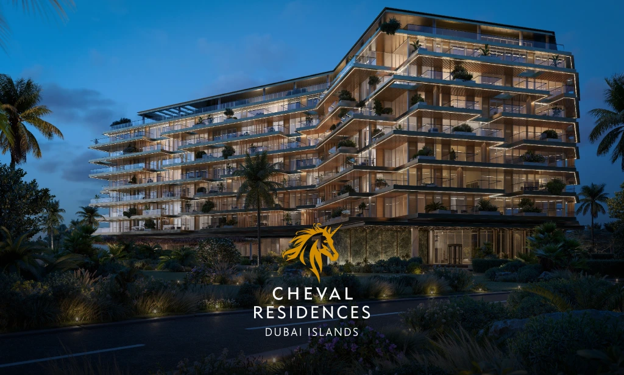
Cheval Residences at Dubai Islands, developed by Wadeen in partnership with AVENEW and operated by Cheval Collection, is designed precisely for this type of investor. Fully furnished, professionally managed, with built-in short-term rental infrastructure and hotel-standard maintenance, it is a property that performs for its owners regardless of where those owners happen to live.